Career Strategy
Frontend Engineering After AI: The Work Shifted Up the Stack
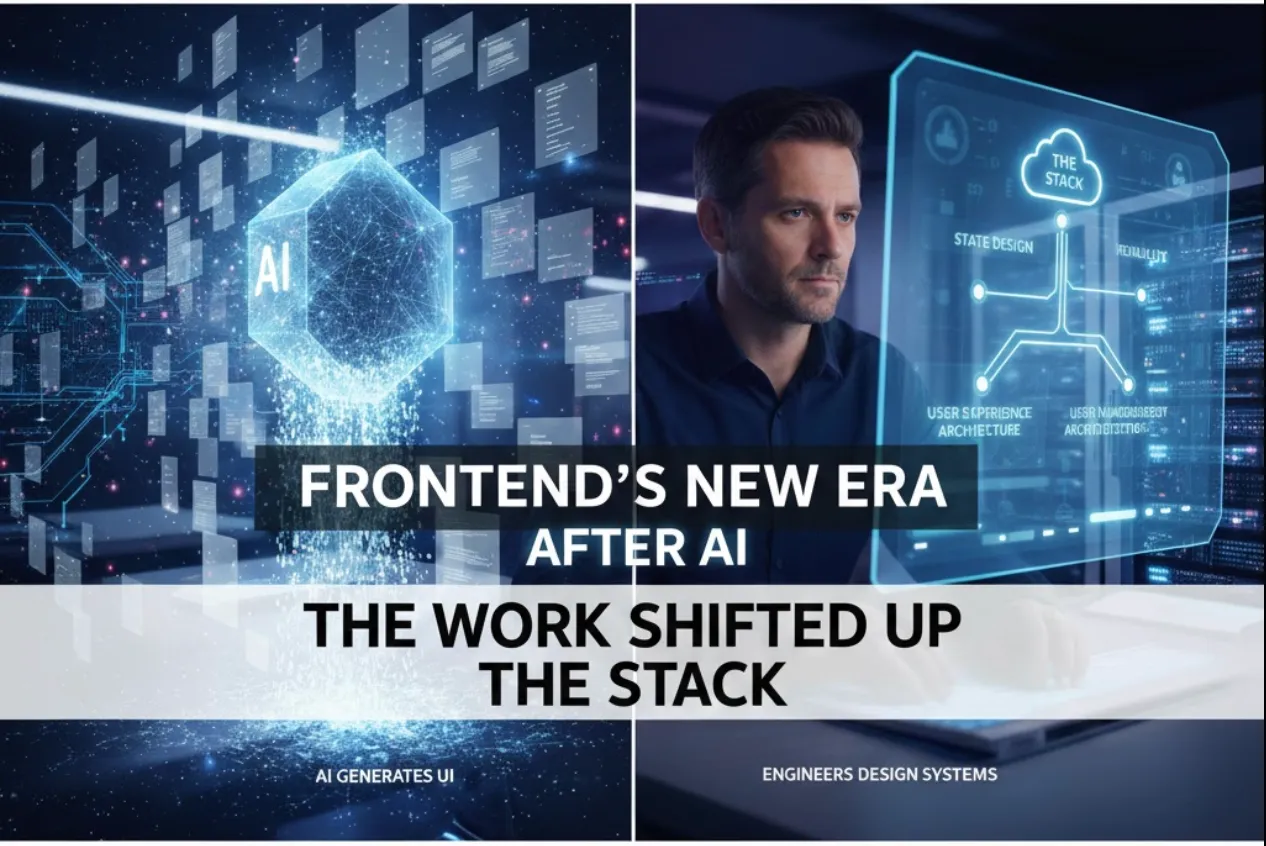
AI can generate UI in seconds, but real product quality depends on engineers who understand state architecture, data synchronization, performance trade-offs, and reliability under real-world constraints. This post explores why frontend is evolving from component building to systems design and what skills now matter most.
AI did not kill frontend engineering. It removed some low-leverage work and made weak engineering more visible.
That is my opinion. But it is grounded in a few facts about how modern products fail.
What is factual today
- AI tools are very good at repetitive UI output.
- Production systems still fail because of state, latency, data consistency, and integration boundaries.
- Users judge products on reliability and responsiveness, not on how fast a team generated components.
- Browsers still run under hard constraints: network variability, main-thread contention, memory pressure, and device diversity.
If those facts hold, then the role is clear: frontend engineering is now less about writing every line manually and more about designing systems that remain correct under pressure.
What AI already automated
AI is now strong at:
- component scaffolding from design files
- basic CRUD pages and forms
- styling variants and utility class generation
- boilerplate tests and docs
- refactors that follow obvious patterns
This is a good outcome. Teams ship prototypes faster, and senior engineers spend less time on mechanical code.
What remains difficult (and valuable)
This is where frontend engineering still earns its keep.
State ownership and data flow
Most bugs in mature products are not “button color” bugs. They are ownership bugs:
- who owns this data
- what is source of truth
- when should UI trust cache vs server
- how should stale data be surfaced
AI can generate code for a pattern. It does not automatically resolve domain invariants for your product.
Async behavior and failure handling
Real products deal with:
- partial API failure
- retries and backoff
- race conditions between requests
- optimistic updates that must rollback safely
- cancellation when user intent changes
These are systems problems. Generated code often handles the happy path first.
Performance as an architecture problem
Performance is not a final polish step. It is shaped by architecture:
- data fetching strategy
- hydration boundaries
- bundle decomposition
- third-party script policy
AI can suggest memoization, but it cannot replace route-level measurement and tradeoff decisions.
Accessibility, security, and compliance
Accessible interactions, auth boundaries, and safe data handling are non-negotiable in production.
These require intent, review, and accountability. They cannot be delegated blindly to autocomplete.
The new expectation for frontend engineers
In my view, the market is separating frontend engineers into two profiles:
- people who produce screens
- people who design reliable user-facing systems
AI compresses value in profile 1 and amplifies value in profile 2.
If you want to remain highly valuable, optimize for:
- state modeling
- API contract thinking
- observability and diagnosis speed
- performance budgets tied to release workflow
- failure-first testing (not only happy paths)
A practical operating model (team level)
If I were setting frontend standards in 2026, I would enforce this baseline:
1. Every feature starts with a state boundary map
Document:
- local UI state
- shared client state
- server authoritative state
- cache invalidation rules
2. Every async mutation defines a failure policy
For each write path, specify:
- optimistic or pessimistic update
- rollback behavior
- retry policy
- user-visible error strategy
3. Every release tracks user-facing quality signals
At minimum:
- route-level error rate
- web vitals trend
- slowest critical journeys
- regression linked to commit/release metadata
4. Every AI-generated change is reviewed for invariants
Code quality review should include:
- does this preserve domain rules
- what breaks under concurrency
- what happens on partial outage
- is this observable in production
Without this, teams move faster only until the first serious incident.
What this means for your career
If you are early in frontend, do not panic about AI. Raise your scope.
Build proof in these areas:
- one project with optimistic UI + safe rollback
- one project with real cache invalidation strategy
- one performance investigation with before/after metrics
- one incident write-up that shows root cause and prevention
Hiring managers may be impressed by speed. They trust engineers who prevent expensive failure.
Final take
Frontend engineering after AI is not smaller. It is sharper.
The low-leverage layer is being automated, which is exactly what should happen. The enduring layer is systems thinking at the product boundary: state correctness, resilience, performance, accessibility, and trust.
The winners will not be the people who type fastest. They will be the engineers who can keep products correct when the environment is messy and users are impatient.